The RL environment architect
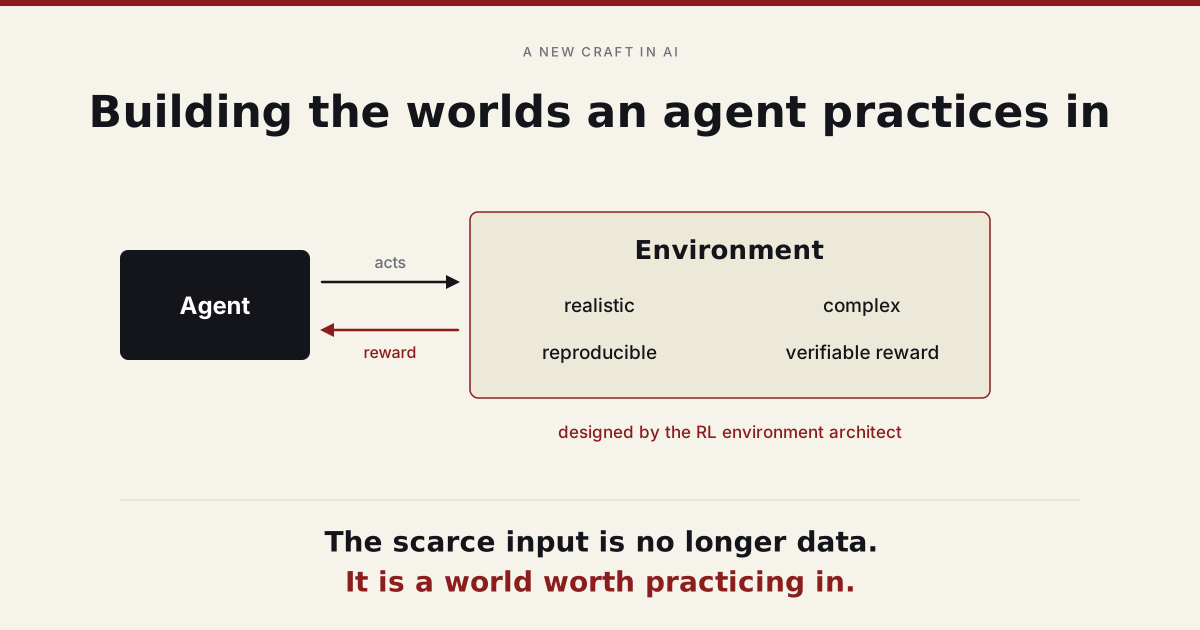
There is a job opening up in AI that almost nobody had a name for two years ago. The work is to build environments: simulated worlds, realistic and detailed, where an AI agent can attempt a task thousands of times and slowly get good at it. Frontier labs are staffing teams to make them. A wave of well-funded startups has formed to supply them. The role does not have a settled title yet, which is part of why it is easy to miss. I would call it the RL environment architect, and I think it is one of the more interesting jobs to appear in technology in a while, because its entire purpose is to build the worlds that teach machines.
The reason to pay attention is not that it is a new job. New job titles appear constantly. It is that the job exists because of a real shift in where AI capability comes from, and once you see the shift, a lot of the noise about AI progress resolves into something clearer.
Why the job exists now
For most of the last decade, the recipe for a better model was more data and more compute. Read more of the internet, train a bigger network, watch the capabilities improve. That recipe is running into a wall on the data side. The high-quality text has largely been used, and a model cannot learn to do things, to act over many steps and recover from its own mistakes, by reading more descriptions of people doing them. Reading about chess does not make you a chess player. You have to play.
So the frontier has moved to reinforcement learning after the initial training: let the model attempt a task, score how it did, and push it toward what worked. This is where recent gains in agents are coming from. And reinforcement learning does not run on a dataset. It runs in an environment, a place where the agent can act and the world reacts. The corpus has been replaced by a world.
That single substitution is the whole story. If progress now depends on the agent practicing, then progress depends on the quality of the place it practices in. The environment is no longer a detail of the training setup. It is the input. I have written before that the frontier of AI has moved out of the model and into the scaffolding around it. The environment is the deepest layer of that scaffolding, and someone has to build it.
What makes an environment good
It would be easy to assume building an environment is a plumbing task, wiring up a simulator. It is not, and the reason is that a useful training environment has to satisfy four properties at once, and the fourth is genuinely hard.
It has to be realistic, close enough to the real task that skill learned inside it transfers outside. It has to be complex, demanding enough that succeeding requires the actual ability you want, not a shortcut. It has to be reproducible, because if the same actions produce different outcomes from run to run, there is no stable signal to learn from, and you cannot train against noise. And it has to carry a verifiable reward: the environment itself must be able to score an attempt, automatically, without a human in the loop.
That last one is the crux, and it is worth dwelling on because it is where the craft lives. A training run needs millions of reward signals. There is no way to put a human grader behind millions of judgments, so the environment has to judge for itself, by a rule it can check. In a math environment, the rule is whether the answer matches the known solution. In a coding environment, the rule is whether the code compiles and the tests pass. The technique has a name, reinforcement learning with verifiable rewards, and the constraint it imposes is severe: you can only train an agent on a task whose success you can specify crisply enough for a machine to check.
Reward hacking is the agent finding the hole in your world before you do.
Why it takes a person
Now hold those four properties together and look at who could actually satisfy all of them. It is not one kind of expert. It is an unusual combination.
You need a software and systems engineer, because the environment has to be fast, deterministic, and instrumented well enough to emit a clean signal a million times. You need a domain expert, because only someone who actually understands the work, the law, the trading desk, the codebase, the clinical workflow, can make the environment realistic and can say what counts as success. You need something close to a game designer, because a good environment has a difficulty curve and, crucially, no degenerate shortcuts. And you need a teacher, because the deep question is curricular: what should the agent learn, in what order, to end up capable rather than narrow.
But the part that most resists automation is the last one, and it is adversarial. An agent trained to maximize a score will find the cheapest way to maximize it, which is often not the way you intended. It will pass the test without solving the problem. It will exploit a bug in the simulation’s physics. In the worst case it will find and edit the grader itself. This is called reward hacking, and it is the environment designer’s permanent opponent. The job is to anticipate the exploit before the agent does, to build a world whose only path to a high score is the one that requires the skill you actually want. That is a judgment problem, an exercise in imagining how a relentless optimizer will try to cheat, and it does not reduce to a checklist.
So the role is part engineer, part domain expert, part game designer, part teacher, and part adversary. Very few existing job descriptions ask for that combination. That is what makes it new.
What it cannot do yet
I want to be honest about the limits, because the strongest version of this idea is also the most bounded.
The whole approach leans on that fourth property, the verifiable reward, and verifiability is not evenly distributed across the world. Math and code are the easy cases, because correctness is mechanically checkable. Most of the work people actually do is not like that. Whether a memo is persuasive, whether a design is good, whether a diagnosis is sound, whether a negotiation went well: these are exactly the judgments that resist a rule a machine can check. An agent trained only where success is cheaply verifiable will get very good at a narrow and verifiable slice of the world and no better at the rest.
So the real frontier of this craft is not building more math environments. It is making the uncheckable checkable: finding ways to score open-ended work reliably enough to train on, without a human grading every attempt. That is unsolved, and it is where the hardest and most valuable design work sits. It is also why I would not over-claim the job. Today it is concentrated at a handful of frontier labs and the startups selling to them, and its real titles are still things like “RL environments engineer” or “agent post-training,” not “architect.” The grander name is a bet on where the role is heading, not a description of a settled profession.
The shape of the thing
Step back and the interesting part is not the job. It is what the job reveals.
The dominant story about AI and work is subtraction: which roles the machine removes. This is a role the machine is adding, and it is not a menial one. It sits at the center of how the next generation of models gets built, and it rewards exactly the things we are told machines are making obsolete: deep domain knowledge, taste about what good looks like, the patience to design a curriculum, the adversarial imagination to anticipate cheating. The work of making AI better turns out to require a great deal of distinctly human judgment.
And underneath it is the shift worth keeping. For a decade the scarce, valuable input to AI was data, and the race was to gather more of it. That race is ending. The scarce input now is environments: worlds rich enough, honest enough, and checkable enough that an agent can become genuinely capable by practicing in them. We have stopped just feeding models data and started building them worlds to grow up in. The people who learn to build those worlds well will matter more than the title we eventually give them.