Progress moved out of the model
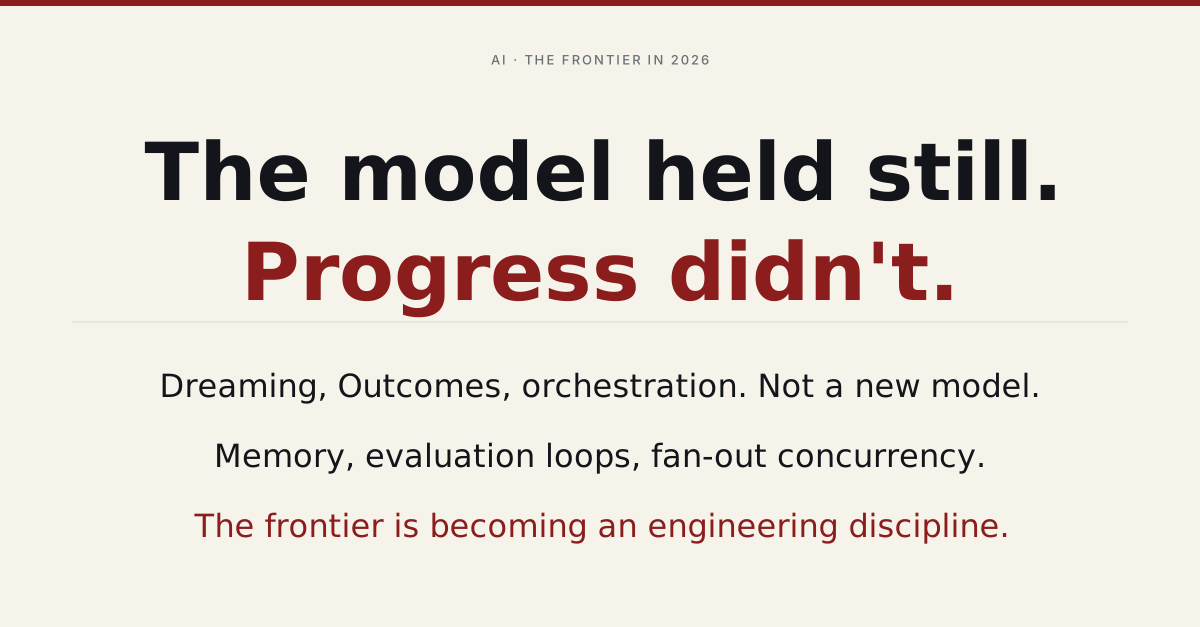
Anthropic’s biggest developer event of the year shipped no new base model.
What it shipped instead was a set of features for agents. Dreaming: a scheduled background process that reviews an agent’s own past sessions, finds the recurring patterns, and writes them into a memory store, so the agent gets better between runs without anyone retraining it. Outcomes: you write a rubric describing what a good result looks like, and a separate grader agent evaluates the work in its own context window and points at what to change. Multi-agent orchestration: a coordinator decomposes a task and hands the pieces to multiple specialist subagents running in parallel, each with its own context window, sharing a filesystem. And a hosted memory store, so an agent loads only the expertise a given request needs instead of carrying all of it in the system prompt.
The wall that isn’t there
The reflexive read on a marquee event with no new model is that the curve is bending. The big jumps are behind us; pretraining is running out of fresh data; scaling is finally hitting the wall everyone has been predicting for two years. A dev day full of plumbing, on this read, is what a plateau looks like.
I think that misreads what happened. The curve didn’t bend. It moved.
The place where this year’s capability gains are coming from is no longer the weights. It’s the architecture around the weights. That shift is easy to miss if you are still watching the one number that used to track progress, whether parameter count, benchmark score, or release cadence. Those numbers can sit still for a year while the thing they were supposed to measure keeps moving somewhere else.
Read the features without the names
Strip the product names off Anthropic’s announcements and look at what each thing actually is.
Dreaming is a scheduled batch job that consolidates state between sessions. Outcomes is an evaluation loop with an independent grader. Orchestration is fan-out concurrency with isolated workers and a shared store. The memory store is a cache, so you don’t recompute the same context on every call.
None of these is a model advance. Every one of them is a pattern any systems engineer would recognize from somewhere else: nightly batch jobs, CI test suites, worker pools, caching layers. What changed in 2026 is not that someone discovered these patterns. It’s that the model underneath got good enough that wrapping it in ordinary engineering started producing extraordinary results.
Progress didn’t stall. It moved out of the model.
The same thing is visible on the compute side. The active scaling axis is no longer how much you spend training a model once; it’s how much you spend running it carefully each time. In high-compute settings, a single hard question can now cost tens of millions of tokens of deliberate reasoning before the model answers. Inference spend has overtaken training spend across the industry. The cost of being smart has moved from capital expense to operating expense, from a thing you do once to a thing you do on every request. That is an architecture decision, not a model property.
Why it matters who improves the system
The interesting consequence is not technical. It’s about who gets to push the frontier, and how fast.
When the gains live in the weights, progress is centralized. A handful of labs with billion-dollar clusters set the pace, and everyone else waits for the next checkpoint to drop. The iteration loop is measured in model generations: a year, give or take. You are a consumer of progress, not a participant in it.
When the gains live in the scaffolding, progress decentralizes. Anyone who can compose a model into a working system can move the capability of that system, this week, without anyone’s permission. The loop shrinks from yearly to weekly. The advantage stops being access to the best weights, which everyone can rent, and becomes the quality of the system you build around them. That is the part that doesn’t arrive in a checkpoint, and the part a competitor can’t simply download.
I have argued before that the model is becoming the substitutable layer, and that better execution makes an agent better at everything, not just at the task you measured. This is the frontier-level version of both. The layer where this year’s improvement actually happens is the layer you build, not the layer you buy.
What this asks of you
If you are evaluating where AI is going by watching base-model releases, you are measuring the wrong axis, and you will keep being surprised by months that look quiet and aren’t. The more useful question is no longer “how good is the model.” It’s “how good is the system around the model”: the memory, the evaluation loops, the orchestration, the decision about how much to spend thinking on a given request.
The most consequential AI work of the year looked a lot like good engineering. For the people still only watching the weights, that reads as a slowdown. For the people who build the thing around the model, it’s the most interesting the work has been in a while.