A stock price to protect
In the space of a few months in 2026, the most valuable private companies of the era lined up to go public. SpaceX listed on June 12 at around a 1.75 trillion dollar valuation, the largest IPO in history, and jumped on its first day. OpenAI filed confidentially, with bankers anchoring a target near a trillion dollars. Anthropic filed on June 1, also reaching for something close to a trillion, in the same season it shipped its most capable model yet. The coverage has settled on a single word for all of it: validation. The AI era, arriving on the public markets at last.
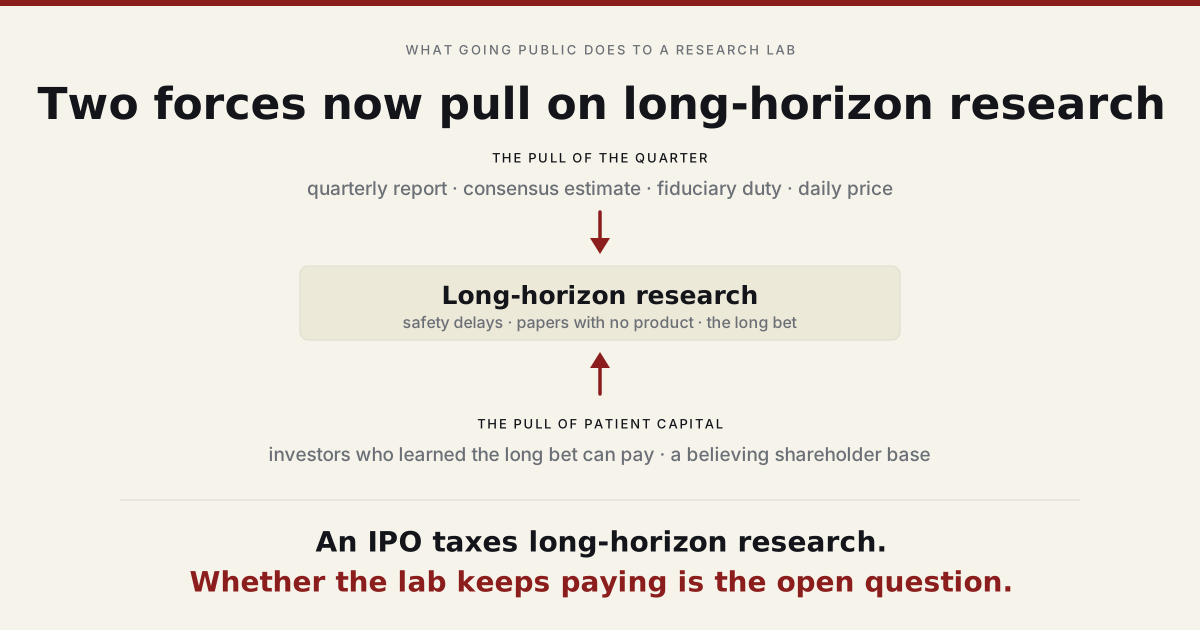
That framing misses what an IPO actually is. Raising money is the visible part. The deeper thing a company does when it goes public is change how it is governed, and for whom. It acquires shareholders it answers to, a quarterly clock it reports against, and a price that updates every second the market is open. For most companies that is a fair trade. For a company whose core product is an open-ended research bet, it installs exactly the kind of pressure that long-horizon research is worst at surviving.
I wrote once about non-profit research labs and called the piece “no product to protect.” The argument was that having nothing to sell is a source of freedom: when no revenue depends on the finding, the finding can go wherever the evidence leads. This is the inverse of that essay. A newly public frontier lab has a great deal to protect. It has a stock price, and a quarter in which to defend it.
I want to be clear up front that this is not a eulogy. Public markets are not where long-horizon work goes to die, and the easy version of this argument, that an IPO will inevitably grind the research out of these labs, is too simple. Markets funded Amazon’s patience for two decades and were richly rewarded for it. More to the point, the investors lining up for these particular offerings have spent the last ten years making their best returns on companies that lost money for years in pursuit of a vision, including the AI buildout itself. The shareholder base that buys a frontier-lab IPO is, to a degree that would have been unimaginable in 2005, self-selected for people who believe in the long bet. So the real question is not whether the quarterly pressure exists. It plainly does. The question is whether it wins, and there are serious forces on the other side. This is a delicate balance, and it could just as easily tip toward the long game.
What going public actually changes
The money is the least interesting part of an IPO. What a company really takes on is an apparatus.
It begins reporting on a ninety-day cycle, in a standardized form, to a market that prices the gap between what it delivered and what it was expected to deliver. It operates under Regulation Fair Disclosure, which since 2000 has required that material information reach everyone at once, formalizing the ritual of the earnings call. Analysts publish a consensus estimate, and the company is measured against that number, not against its own plan. Its directors take on a fiduciary duty to shareholders. And every decision it makes is scored, continuously, by a price it does not control.
None of this is sinister. It is the machinery that lets strangers trust a company enough to fund it, and it has financed most of the productive economy. But it has a property worth naming plainly: it rewards what is legible. A number you can report this quarter, a product you can ship, a metric an analyst can put in a model. The apparatus is very good at valuing those things and very bad at valuing what cannot yet be counted.
The question is not whether more capital is good for an AI lab. It obviously is; the buildout is staggeringly expensive. The question is what the legible-metric machine does to work that is, by its nature, illegible.
The evidence that the quarter wins
We do not have to guess at how that pressure resolves, because the people who feel it have told us.
In a survey of 401 chief financial officers, the economists John Graham, Campbell Harvey, and Shivaram Rajgopal found that a startling majority would trade real value for the appearance of stability. Seventy-eight percent said they would sacrifice long-term economic value to deliver smooth earnings. Fifty-five percent said they would decline a genuinely positive project, one worth more than it cost, if taking it on meant missing the current quarter’s consensus number. And eighty percent said they would cut spending on research and development, advertising, and maintenance to hit an earnings target. These are not accusations from a critic. They are admissions from the executives themselves, about what the apparatus makes them do.
The behavior shows up in the aggregate too. Comparing otherwise similar public and private companies, the economists John Asker, Joan Farre-Mensa, and Alexander Ljungqvist found that private firms invest at roughly twice the rate of their public counterparts, and respond several times more sharply to a new opportunity. The gap was widest in exactly the industries where stock prices react most strongly to earnings news. The more a company’s price hangs on the quarter, the less it invests in the future.
I should be careful here, because this is contested ground. A serious group of scholars argues that short-termism is overstated, that markets do reward patient investment, and they point to Amazon and Tesla as proof that a public company can spend years losing money on a bet and be celebrated for it. They are right that it is possible. But the cleanest version of the claim survives their objection: going public installs a reporting-and-consensus apparatus that executives, by their own testimony, will sacrifice real value to satisfy. A company that wants to stay long-horizon under that apparatus has to actively defend itself against it. It does not happen by default.
From no product to protect, to a price to protect
Now hold that next to what an AI lab actually does.
The work that made these labs valuable is the least legible work there is. It is research that may not pay off for years. It is the decision to delay a release because a model failed an internal safety evaluation. It is publishing a finding that complicates your own product, or pouring effort into interpretability research that ships nothing a customer can buy. None of that has a line on a quarterly report. All of it is the kind of spending that eighty percent of executives said they would cut to make a number.
Going public doesn’t ban long-horizon research. It taxes it, and the tax comes due every ninety days.
The pull toward the legible was visible inside these companies before any of them filed. When the OpenAI safety researcher Jan Leike resigned in 2024, he said plainly that at the company safety had “taken a back seat to shiny products.” That was while OpenAI was still private, still nominally controlled by a non-profit board. There is a sharper version of the same tension in the present moment: the same labs that have publicly called for the industry to slow down, to coordinate, to treat the technology as dangerous, are filing to become companies that must ship something new and hit a revenue target every three months. It is hard to hold both postures at once. A public company does not get to decide that this quarter it would rather do careful research than grow.
The buffers they built
To their credit, the labs saw this coming, and neither walked into the public markets naked. Each engineered a governance structure meant to keep the mission in control of the money.
OpenAI restructured so that its for-profit arm, OpenAI Group PBC, is a public benefit corporation controlled by a non-profit foundation, which holds roughly a quarter of the equity, a stake worth around 130 billion dollars. That control sits inside a dense web of commercial gravity: Microsoft holds about 27 percent, and the restructuring came bundled with a commitment by OpenAI to buy a reported 250 billion dollars of Microsoft’s cloud compute. The mission may sit atop the structure, but it is wired to a balance sheet that needs revenue at enormous scale. Anthropic is a public benefit corporation with a Long-Term Benefit Trust, a body of trustees chosen for their independence from financial interest, which holds a special class of stock that lets it elect a growing share of the board, rising to a majority within about four years. These are not cosmetic. They are real attempts to wire a mission into the cap table, and they have a distinguished ancestor: when Google went public in 2004, its founders wrote that “Google is not a conventional company. We do not intend to become one,” declined to give earnings guidance, and took a dual-class structure specifically so public-market pressure could not force a short-term pivot.
But there is a difference between the Google move and the one the labs are attempting, and it is the whole point. Google’s founders entrenched founder control. The ask was ordinary: let me keep running the company my way. The labs are trying to entrench mission control, which is a far harder thing to make durable, because the mission is not a person in the room who can say no.
And the structures are conditional by their own design. Anthropic’s trust comes with what the company itself calls “failsafe” provisions: a sufficiently large supermajority of shareholders can amend the trust’s powers and override its trustees, and the thresholds are not public. Legal scholars who studied the arrangement called it a “modest experiment” in governance, and a Harvard Law Review analysis of the broader pattern warned of what it termed “amoral drift,” the slow erosion of mission commitments under commercial pressure. OpenAI’s control structure has already bent once. In November 2023 its non-profit board fired Sam Altman, and within days he was reinstated, the board reconstituted, under pressure from investors and employees. The formal authority was real right up until it collided with the money, and then it gave way.
SpaceX, going public in the same window, is the clean contrast. It uses an ordinary dual-class structure that leaves Elon Musk with the overwhelming majority of the voting power. That is the easy version of resisting the market: a founder keeping control. Nobody has to wonder whether Musk’s interests survive the IPO, because he is a person with votes. A mission has no votes. It has only the structure built to speak for it, and that structure holds exactly as long as the shareholders let it.
The case it goes the other way
It would be easy to take this too far, and the other side of the argument is strong enough that I think it may well win.
Public markets are not where good long-term work goes to die. Amazon spent two decades being told it should be profitable and refused, and its 1997 shareholder letter said the quiet part out loud: “when forced to choose between optimizing the appearance of our GAAP accounting and maximizing the present value of future cash flows, we’ll take the cash flows.” Google ran enormous money-losing research bets as a public company for years. The market can absolutely fund patience.
And the market has changed since those executives were surveyed in 2005. The defining lesson of the last two decades of investing is that the largest returns came from companies that lost money for years in service of a vision and turned out to be right. That lesson has been internalized. The long-term-letter, no-guidance, dual-class playbook that Google’s founders had to invent and defend in 2004 is now a recognized strategy with a deep pool of investors trained to underwrite it. A frontier lab that tells its shareholders plainly that it will spend on research that does not ship, and delay products that are not ready, is not making an outlandish ask in 2026. It is making an ask the market has learned, at least sometimes, to say yes to. The shareholder base self-selects: the people who buy a money-losing AI lab at a trillion dollars are, almost by definition, buying the long bet.
But notice what those companies needed in order to do it. They needed founders with voting control, an explicit refusal to play the guidance game, and a base of shareholders who bought the long-term story on purpose. The freedom to think long was not granted by the market. It was bought with structure, and defended every year. The cleanest historical model of patient corporate research makes the point by its absence from the market entirely: Bell Labs produced the transistor, information theory, and the laser on the back of a regulated monopoly’s guaranteed profits. It could afford fifty years of long-horizon research precisely because it was insulated from the quarterly market, not exposed to it.
So the honest read is not that the labs are doomed. It is that they are attempting something genuinely hard, keeping open-ended research and safety work funded while a public market prices them every day on their products, and that the structures meant to protect that work are a bet, not a guarantee. The bet is closer to even than either the doom story or the validation story will admit.
What an IPO selects for
Here is the thing to watch, and it will not arrive as a headline.
No company announces that it has started caring more about the quarter. The change, when it comes, is quieter than that. It shows up as a gradual reweighting of what is easy to fund and what requires a fight. The legible thing, the shipped feature, the revenue line, the metric in the analyst’s model, becomes a little cheaper to defend each quarter. The illegible thing, the safety delay, the research with no product attached, the paper that makes the model look worse, becomes a little more expensive. Nobody decides to abandon the mission. The mission just becomes the line item that always has to justify itself, against a number that never does.
You can see the shape of it in advance. Picture the first earnings call after a quarter where growth came in soft. An analyst asks why operating expenses are so high, and somewhere in the answer is a large number attached to research that shipped nothing and a safety process that delayed a release a competitor did not delay. The honest answer, that this is the work the company exists to do, does not fit the format. The format wants the number to come down next quarter. It will not happen in one call. It happens across forty of them, each one making the unbudgeted, unshippable work a little harder to defend, until the easiest path is simply to do less of it. That is not a scandal. It is the apparatus doing exactly what it was built to do.
It can also go the other way, and that is the case I find genuinely live. Picture the same call with a different CEO, one who declines to give guidance, points to a letter written at the IPO that promised exactly this spending, and is backed by a shareholder base that bought in because of the long bet rather than in spite of it. That is not a fantasy. It is what Jeff Bezos did, quarter after quarter, for twenty years, and the market eventually rewarded him for it more richly than almost anyone in history. The labs have the same tools available, and this time a market that has already seen the movie and knows how it can end.
An IPO does not ban long-horizon research. It taxes it, and the tax comes due every ninety days. Whether a company keeps paying that tax is a choice it has to make on every one of those days.
The non-profit labs I wrote about have nothing to protect, and that is their freedom. The companies going public this year have something to protect now, a price, and the iron law of having something to protect is that you protect it. The open question is whether protecting the price and protecting the mission turn out to be the same thing or opposite things, and the honest answer is that it could go either way. The pressure is real; so is a market that has, for once, already learned what patient bets are worth. Whether these labs become the next Amazon or the next cautionary tale is the most interesting governance question in technology, and we are about to run the experiment in public, with the most consequential companies of the era as the subjects. What changed in 2026 is that the question stopped being hypothetical.