The boundary of the firm
The heads of the leading AI labs have predicted that AI will soon make possible the first one-person billion-dollar company. It is a good line because it is almost imaginable. Give a single capable founder a fleet of agents to write the code, answer the customers, run the books, and draft the contracts, and the headcount that used to be load-bearing starts to look optional. Early claimed examples are already surfacing, though their headline revenue numbers tend to be projections rather than audited results. But the prediction keeps circulating, because the intuition behind it feels right.
The intuition is about headcount, and headcount is the surface. Underneath it is an older and more interesting question, one that a young economist asked in 1937 and that the industry is now, without quite realizing it, asking again. Not “how few people can run a company,” but “why is there a company here at all, instead of a market.” AI is reaching all the way down to that question. And the answer it returns is not the clean one the prediction assumes.
Why there are companies at all
In 1937 Ronald Coase noticed something that economics had mostly stepped around. Economists praised the market as the efficient way to coordinate activity, with prices guiding resources to their best use through countless voluntary trades. Fine. But if the market is so efficient, Coase asked, why is so much of the economy organized inside companies, where a manager directs work by authority and the price mechanism is deliberately suspended? Why does an employee do what a boss says rather than negotiating each task as a separate trade?
His answer was that using the market is not free. “The main reason why it is profitable to establish a firm,” he wrote, “would seem to be that there is a cost of using the price mechanism.” To buy something on the open market you have to find who sells it, discover the price, negotiate terms, write a contract, and police it afterward. Each step costs time and effort. When you do the same thing often enough, it becomes cheaper to stop transacting and start organizing: hire a person, give them authority over you in exchange for a salary, and skip the repeated negotiation. A company is what you get when coordinating work under one roof is cheaper than buying it piece by piece in the market.
That gives a precise definition of how big a company should be. A firm keeps growing, Coase argued, until “the costs of organizing an extra transaction within the firm are equal to the costs involved in carrying out the transaction in the open market.” Past that point, you should buy rather than build. Before it, build rather than buy. The boundary of the firm is just the line where those two costs meet.
The boundary moves when the costs move
If the boundary is where two costs balance, then the boundary is not fixed. Change either cost and the line slides.
Oliver Williamson spent a career making this precise, work that won him a Nobel in 2009. His refinement was to ask which kinds of work fall on which side. Activity that is standardized, easy to specify, and easy to verify is cheap to buy, because you can write a simple contract and check that you got what you paid for. Activity that is specialized, hard to specify, and exposed to a partner who might exploit you once you depend on them tends to get pulled inside, where authority and shared incentives substitute for a contract you could never write completely.
A company, then, is a standing answer to a make-or-buy question asked across every function it has, and the answer is always provisional. It holds only as long as the relative costs that produced it hold. So the interesting force in the theory is anything that durably changes those costs, and the usual such force is technology. A technology that lowers the cost of coordinating across a market boundary pushes work out of firms; one that lowers the cost of coordinating inside an organization pulls work in. The theory has no opinion about which is coming. It only tells you to watch the costs.
We have run this experiment before
This is the part worth sitting with, because the temptation with AI is to reason as if no comparable thing has happened. It has, more than once, and the most recent time is close enough to be a warning.
In 1987, Thomas Malone, JoAnne Yates, and Robert Benjamin took Coase’s framework and pointed it at the computer. Information technology, they argued, mostly lowers the cost of coordination: the cost of finding partners and prices and moving information between them. By the logic above, lowering that cost should push activity out of hierarchies and into markets. They said it plainly: information technology “will lead to an overall shift toward proportionately more use of markets rather than hierarchies.” Firms should disaggregate. Buying should beat building. The vertically integrated giant should give way to the nimble network of specialists.
For a while, that is what seemed to happen. Falling shipping and communication costs, the standardized container chief among them, let companies unbundle production and scatter it across the globe. Ford’s River Rouge plant, which in the 1920s took in iron ore at one end and rolled finished cars out the other under one owner, was the monument to the old way; by the late 1990s the carmakers had spun their parts divisions out and bought components from a market of suppliers. Payroll, support, and accounting got shipped to contractors halfway around the world once cheap telecom made distance manageable. The internet drove the cost of finding a buyer or a worker toward zero and gave us marketplaces, the gig economy, and infrastructure rented by the API call. The prediction looked prophetic.
And then the same technology produced the opposite. The decades that were supposed to dissolve firms into markets also produced the most dominant companies in history. Industry after industry grew more concentrated, not less. By one influential and contested estimate, from De Loecker, Eeckhout and Unger, the average markup of price over marginal cost across US firms rose from about 21 percent in 1980 to roughly 61 percent in 2016, with most of the rise driven by a handful of firms at the top pulling away from everyone else. (Critics such as James Traina argue the measure overstates the rise by treating overhead and marketing as if they were not variable costs, so read it as a direction, not a settled number.) The point survives the dispute: the same IT that favored the market also handed scale to the giant, through network effects, data feedback loops, the near-zero marginal cost of software spread over a global user base, and capital intensity. The same force pushed in both directions at once.
The researchers’ own field eventually walked the clean prediction back to something humbler: it depends on the transaction. The deeper history made the same point in reverse. The railroad and the telegraph, a century earlier, had lowered the cost of coordinating at a distance and produced not a market of small traders but the large managerial corporation, the visible hand of professional management replacing the invisible hand wherever administration turned out to be cheaper than transacting. Technology has no fixed bias about how big a company should be. It moves the boundary toward whichever side it cheapens more, and you have to look at the specific costs to know which side that is.
What AI actually makes cheap
So the question to ask about AI is not whether it shrinks or grows companies. It is which costs it lowers, and which it leaves alone.
What AI lowers is dramatic and easy to see. It collapses the cost of producing knowledge work: a first draft of code, a contract, a financial model, a research memo, a support reply. It collapses the cost of finding and matching, the same search cost the internet went after, now extended to anything you can describe in words. It collapses the cost of translating between formats and systems, the connective tissue that used to require a person. For a wide range of tasks that used to require hiring someone, the production cost is falling toward the price of the tokens.
What AI does not lower, and in some ways raises, is the cost of trusting the result. A model produces a contract in seconds, but someone still has to be sure it is right, and the model will produce a confidently wrong one with the same fluency as a correct one. When the work was slow and human, verification rode along with production; the person who did it caught most of their own errors and could be held responsible for the rest. When production becomes nearly free and nearly instant, verification splits off into its own cost, and it does not fall the way production does.
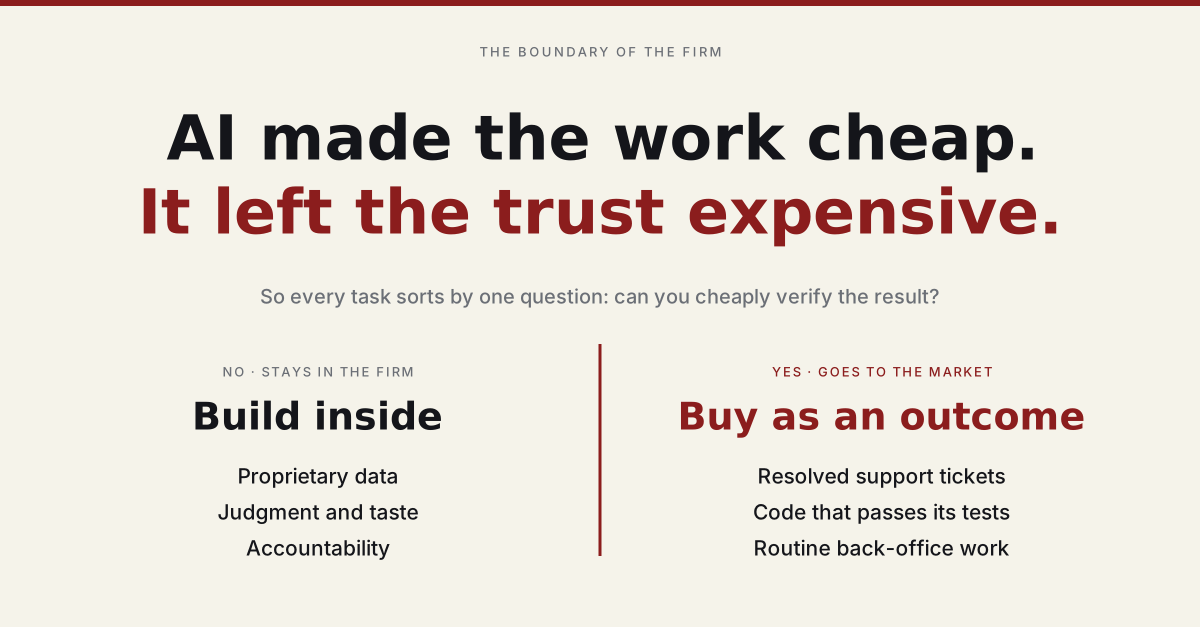
AI made the work cheap. It left the trust expensive.
It helps to break “trust” into the specific questions a make-or-buy decision actually has to answer:
- Can you tell whether the output is correct? If verification is cheap and unambiguous, you can buy the result without watching the process.
- Who bears the cost if it is wrong? Someone has to be accountable, and a contract with a vendor reallocates liability differently than an employee under your authority does.
- Does the task require private context? Work that depends on data or institutional knowledge a market participant does not have resists being bought.
- Does repeated use create proprietary learning? Work that compounds into a moat the more you do it is work you want to own, not rent.
AI makes the producing cheap everywhere. But it only makes the buying safe where the answers run the right way: where output is verifiable, liability is cleanly assignable, no private context is needed, and nothing proprietary accrues from doing it in-house. Where they run the other way, the work stays inside, or moves further in. The theory predicts not a direction but a sorting.
Both directions at once
That sorting is visible right now, pulling against itself.
On one side, work is moving to the market in a genuinely new form. A growing set of companies no longer sell software that a human operates; they sell the completed task, priced by the outcome. Intercom’s Fin charges $0.99 per resolution rather than per seat, billing only when its AI agent actually closes a customer’s issue, and rivals like Sierra and Decagon have adopted the same outcome-based model. The category has a name now. Foundation Capital’s Ashu Garg calls it “services-as-software,” where the product is the finished work rather than the tool, and the prize is not the roughly $200 billion enterprises spend on SaaS but the $4.6 trillion they spend on salaries and services. This is the make-or-buy line moving exactly where the theory says it should: toward buying, for work whose result is easy enough to verify that you will pay for the outcome and not watch the process. The same logic lets small teams run large businesses. Midjourney crossed an estimated $200 million in annual revenue around 2023 with roughly 40 employees and no venture capital, about $5 million of revenue per head, by buying or automating the functions it would once have staffed.
On the other side, work is consolidating into large firms for reasons the theory predicts just as cleanly. When the cost of writing code falls to nearly zero, the durable advantage is no longer the code; it is the proprietary data, the embedded relationships, and the accumulated process a newcomer cannot replicate. Writing about the legal-AI company Harvey, a16z partners Alex Immerman and Santiago Rodriguez argued that once a tool absorbs how a firm structures its work, “there is simply no way a new entrant can replicate that overnight, even with the cost of code being zero,” locating the moat in embedded process rather than in code. (They are Harvey’s investors, so read it as the bull case; the mechanism is sound regardless of who is making it.) The frontier models themselves are produced by a handful of firms spending sums only giants can carry: in 2026 Amazon, Microsoft, Alphabet, and Meta are on track to spend roughly $725 billion in capital expenditure, the bulk of it AI infrastructure, up about 77 percent year over year. And some work that firms once pushed out to contractors has reason to come back in, because once an agent can do it cheaply under your own supervision, the cost that justified outsourcing it can disappear.
The honest thing to say is that the triumphant version of either direction is not yet real. When Klarna said in February 2024 that its OpenAI-built assistant was doing the work of 700 full-time agents across 2.3 million chats a month, the figure was hiring it had avoided rather than staff it had fired, and by 2025 the company was recruiting humans again after CEO Sebastian Siemiatkowski conceded that leaning too hard on cost had produced lower-quality support. Cursor, built by Anysphere, sold a $20 plan that promised generous access to frontier models, then found that each newer, more capable model cost more per request rather than less, and shifted in mid-2025 to usage-based pricing that now steers heavy users toward its $60 and $200 tiers. The cheap part got cheaper; the expensive part moved, and the pricing chased it. The boundary is moving. It is not stampeding in the direction anyone’s slide deck claims.
The org chart is a calculation
What this changes, if you are building something, is the question you ask about your own company.
The instinct right now is to ask how few people you can get away with, as though small headcount were the goal and AI the means. That is the surface question, and it gets the logic backward. The real question is the one Coase pointed at: for each function your company performs, has AI made it cheaper to coordinate inside or to buy as a finished outcome on the market? Run it through the four questions. Where the output is verifiable, liability is assignable, no private context is needed, and nothing proprietary accrues, the answer has flipped to buy, because someone will now sell it by the result. Where any of those run the other way, the answer is more firmly build than ever. The org chart stops being a fixed structure and becomes a live calculation, repriced function by function, as the costs move.
The companies that do well will not be the smallest or the largest. They will be the ones that put each piece of work on the right side of the line, and move it when the line moves. That has always been the skill; AI has only made the line move faster and in more places at once.
A company was never a fixed thing. It was always a bet about what was cheaper to coordinate than to buy, placed function by function and renewed every year whether anyone noticed or not. AI is forcing everyone to place the bet again, all at once, across every function at the same time. The answer will not be one-person companies, and it will not be the old org chart with fewer chairs. It will be, as it was in 1987, messier and more specific than either side wants it to be. The only safe prediction is that the line is going to move, and that the work of running a company is increasingly the work of knowing where to put it.