Scientific coding is the frontier
The most valuable thing an AI could learn is to write the kind of software that does science: the simulation, the numerical model, the analysis pipeline that turns a hypothesis into a result. Not another web app or business dashboard. Everyday coding is largely solved now. Scientific coding is not, and it is the harder problem by a wide margin.
The gap matters well beyond the lab, because of a pattern that keeps repeating. The hardest demands in computing have usually come from science, and the tools built to meet them did not stay there.
Science writes the tools first
FORTRAN was built in 1957 so physicists and engineers could write formulas instead of machine code. It became the first high-level language and the ancestor of most that followed. The fast Fourier transform was pushed into its modern form partly to detect Soviet nuclear tests from seismic data, and it now runs inside every phone call and every image you load. Monte Carlo methods came out of Los Alamos and the problem of neutron diffusion. The web was built at CERN so particle physicists could share results, and you are reading this on it. IEEE floating point, the arithmetic almost every program quietly depends on, was standardized largely because numerical scientists needed answers they could trust. The GPU went from drawing triangles, to running physics simulations, to running essentially all of modern AI.
The pattern is consistent. Science asks for something the available tools cannot do, someone builds it, and a decade later it is infrastructure for everyone. Scientific computing is upstream of mainstream computing far more often than the people downstream notice.
Why it is the hard one
Everyday coding became a solved direction for models because it comes with a built-in answer key. A test passes or fails. The compiler accepts the program or rejects it. The button works or it doesn’t. That dense, instant feedback is exactly what let models get good at it: a flood of examples, each with a clear signal for right and wrong.
Science usually has no answer key. Often the whole point of the program is to compute something nobody knows yet, so there is nothing to check the output against. And when scientific code is wrong, it rarely crashes. It returns a clean number and a convincing plot that are quietly, confidently incorrect: a sign convention flipped, units that don’t line up, a numerical method that happens to be unstable in this one regime. The failures are silent, and catching them takes a trained sense of what the answer should look like before you have it.
The deeper difficulty is that the reasoning is hidden inside choices that look like ordinary code. Which approximation to make, which terms to drop, which method holds up here and falls apart there.
A model can write a flawless solver for the wrong equation.
The code is the easy part, maybe a fifth of the real work. The science is in the judgment around it, and that judgment is the least written-down knowledge in any field. It lives in apprenticeship, and in the runs that didn’t work and never got published.
What crossing it would do
Close that gap and two things follow. The obvious one is acceleration. Drug discovery, materials, fusion, climate, large parts of biology all bottleneck on the slow loop between an idea and a computed result. Compress that loop and the gains compound across every field that runs on simulation, which by now is most of them.
The less obvious one is the forcing function again. To make science checkable for a machine, you have to build the missing answer keys: simulators that expose a ground truth you can measure instead of trust, differentiable models that hand back a gradient to follow, scaffolding that can tell a real result from a plausible one. Those tools are general. The same way FORTRAN and the GPU escaped their original purpose, the machinery built to grade scientific work will become infrastructure ordinary software inherits. And it compounds in a tighter loop than before, because an AI that can do science helps build the tools that make AI better.
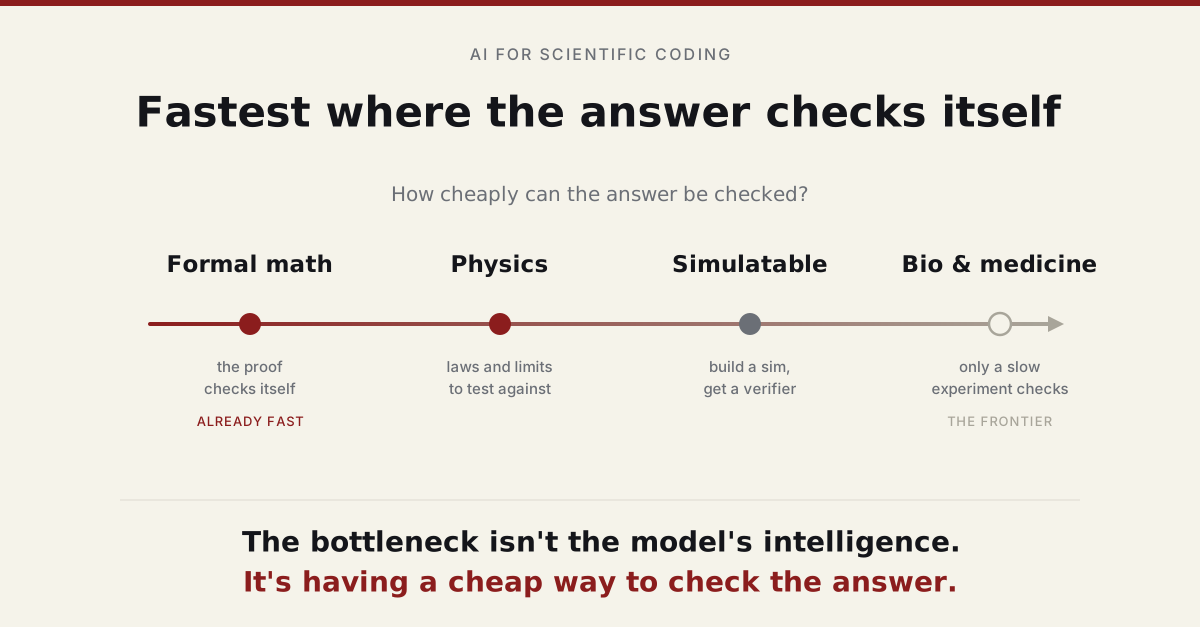
So the binding constraint is not really the model’s intelligence. It is that most of science has no cheap way to grade an answer, and you can neither train nor trust what you cannot check. The fields with built-in answer keys move first. Formal mathematics, where a proof checks itself, is already moving fast. Physics, with conservation laws and limiting cases to test against, is close behind. The empirical fields gated by a slow, expensive experiment, much of biology and medicine, come last, and in the meantime they are the most exposed to the failure mode: plausible, wrong results produced faster than anyone can audit them.
Which makes the real work quieter than it sounds. Not a model that has memorized more science, but the patient construction, one field at a time, of worlds that can grade themselves. That has always been the harder half of computing. It is also, every time so far, where the next set of tools came from.